The Shield and the Sap: A Study in Diptyque’s Olfactory Asceticism
- Aurélie Benchetrat
- Jun 20
- 4 min read

Updated: Jul 23

The word niche has lost its coordinates to me, honestly. In a contemporary market flooded with loud, high-performance synthetic molecules engineered to scream for attention across vast retail spaces, true luxury is no longer defined by volume. It is defined by restraint.
Sixty years after opening a tiny curiosity boutique at 34 Boulevard Saint-Germain, Diptyque remains a singular entity in perfumery, operating not as a cosmetic brand, but as an ongoing dialogue between fine art, memory, and botanical realism. To understand why this house commands such reverence among serious fragrance historians, one must look past the consumer success and examine the strict, self-imposed discipline of its creative process.
This is an exploration of a house that refuses to simplify its complexity, choosing instead to treat fragrance as one of the last intimate luxuries.
The Counter-Revolution of Intimacy
The modern fragrance landscape is dominated by visibility. Scents are frequently formulated to project a loud identity statement, carving out digital personas before they are even sprayed on skin. Diptyque’s entire philosophy acts as a direct resistance to this visual clamor. Perfume here is treated as an invisible, intangible sanctuary, a private language spoken exclusively to those close enough to listen.
This creates a fascinating paradox. While commercial perfumery relies on aggressive sillage and linear synthetic fixatives to ensure longevity at all costs, Diptyque focuses on transparency. Their compositions possess a unique watercolor texture.
By pairing premium natural raw materials with spacious, modern synthetics, they create physical gaps in the scent structure. Light passes through these perfumes rather than hitting a wall of dense, opaque notes. It is a sensory gesture meant to be lived from within, converting the act of wearing fragrance into an entirely unshared moment with oneself.

The Praetorian Portal and the Typographic Puzzle
This visual philosophy is anchored on the bottle itself. The famous oval label, designed by co-founder Desmond Knox-Leet, traces its lineage to an ancient Roman Praetorian shield. It serves as a visual portal.
Because the house has refused to classify its line by gender since 1968, the illustration must perform the work of the traditional marketing brief. It does not sell an identity; it rather charts a landscape, a Möbius.
Knox-Leet, drawing on his background in wartime cryptology, created a typographic dance inside the shield. The scrambled calligraphy forces the brain to slow down, deciphering the name letter by letter. This initial friction demands an intellectual engagement that sets the tone for the olfactory experience. Furthermore, the dual-sided print utilizes the liquid inside the bottle as a magnifying lens.
Looking through the glass reveals a secondary landscape that completes the narrative, establishing what the house terms the alliance of the hand and the nose. The sketch provides the exact nostalgic atmospheric context before the liquid ever meets the pulse points.
The Anatomy of the Accident: Two Case Studies
The aesthetic elegance of Diptyque lies in its ability to capture uncompromised, photorealistic plant life without ever falling into crude naturalism or synthetic abstraction.
This equilibrium is achieved through the deployment of an olfactory accident, an intentional compositional disruption that mimics the irregular patterns of human memory.

Philosykos (1996): The Architectural Fig
Composed by Olivia Giacobetti, Philosykos completely dismantled the traditional green accords of the twentieth century, which relied heavily on bitter galbanum or soapy oakmoss. Giacobetti mapped the entire ecosystem of a wild Grecian grove in the heat of summer, dividing the trees into a three-part botanical anatomy.
The top notes introduce a sharp, crunchy greenness via a precise dose of Stemone, replicating the physical sensation of snapping a bitter leaf between the fingers. In the heart, the composition transitions into a milky, fluid texture using vegetal lactones. This captures the sticky, white sap of the branch without introducing any sugary, tropical confectionery notes. Finally, the base grounds the experience with a dry cedar wood, evoking sun-bleached bark and arid Mediterranean soil. The sweetness of the fruit is intentionally suppressed to keep the focus on the raw, green lifecycle of the flora.
Tam Dao (2003): The Sandalwood Sanctuary
Where mainstream woody fragrances lean on heavy, ambery bases or rich vanilla cushions to satisfy commercial panels, Tam Dao operates with strict architectural minimalism. Inspired by Yves Coueslant’s childhood memories of Northern Vietnam, the scent acts as a tribute to raw timber and sacred spaces.
The opening is bracing and cold, using cypress and Italian myrtle to mimic the crisp air of an elevated mountain forest. As the green top notes evaporate, the heart reveals an unpolished, dry cedar wood that feels like the interior of an ancient temple. The magic of Tam Dao lies in its base, where the creamy facets of Goan sandalwood are suspended in mid-air by a sheer layer of white musk and dry spices. The musk behaves like cool incense smoke, smoothing the rough grain of the wood while maintaining an intimate, low-projection profile that clings tightly to the skin.
From Skin to Scenography
This rigorous discipline extends effortlessly into the home.
Diptyque treats home fragrance not as a utility to mask an environment, but as decorative scenography. The hourglass diffuser, operating entirely on gravity and capillary action without the aid of electricity or screens, slow-releases its contents at a meditative pace, literalizing the passage of time.

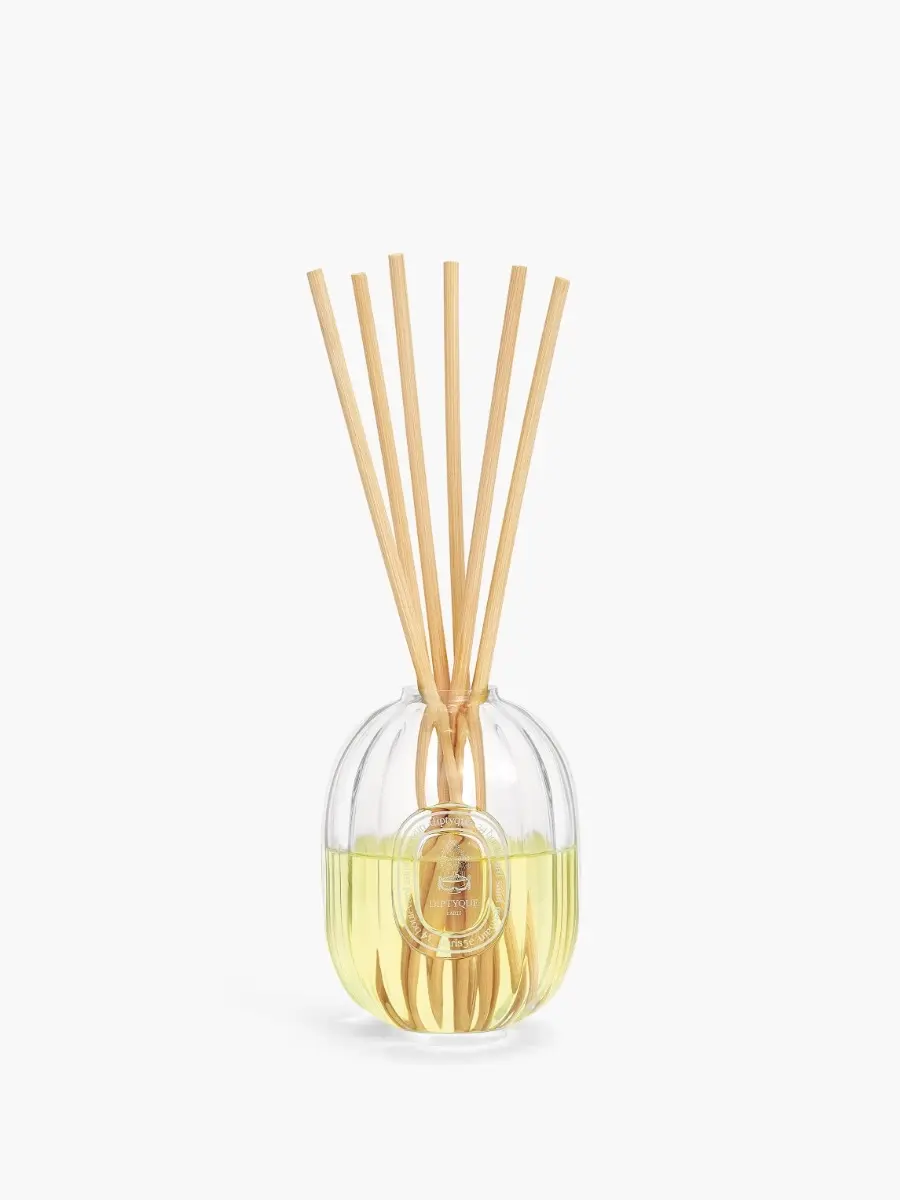
This poetic commitment reached its logical peak in 2022 with the introduction of La Droguerie. By taking utilitarian household cleaning products and infusing them with an uncompromised, raw garden profile of basil, spearmint, and tomato leaf, the house successfully elevated the most mundane daily chores into aesthetic rituals.
Ultimately, Diptyque remains an essential subject of study because it treats the consumer as an intellectual collaborator.
By rendering its narrative illustrations strictly in black and white ink, the house refuses to color your imagination. They provide the structural framework, the premium raw materials, and the artistic history, leaving the final canvas completely open for the most crucial ingredient of all: the wearer.

If you haven't experienced it yet, a visit to your local Diptyque store is one of the best experiences you can gift yourself with, especially during the Holidays where everything is transformed into a magic bubble.
And I highly recommend a candle as a gift. Not sure which one? They have created an online interactive gift finder HERE.


Comments