


The Man Who Broke a Bottle and Changed Everything: COTY then and now.
- Aurélie Benchetrat
- Jun 3
- 4 min read


François Coty (1874–1934) was a French perfumer, businessman, and newspaper publisher who founded Coty, Inc., one of the world's largest fragrance companies.
Known as the "father of modern perfumery," he revolutionized the industry by mass-producing luxury fragrances and utilizing elegant packaging by master glassmakers like Lalique.
Born Joseph Marie François Spoturno in Ajaccio, Corsica, he moved to Paris and adopted the name François Coty, a variation of his mother's maiden name. He studied perfumery under a local pharmacist and set out to modernize an industry that had changed very little since the 19th century. What he built in the decades that followed would redefine not just how perfume was made, but who it was made for.
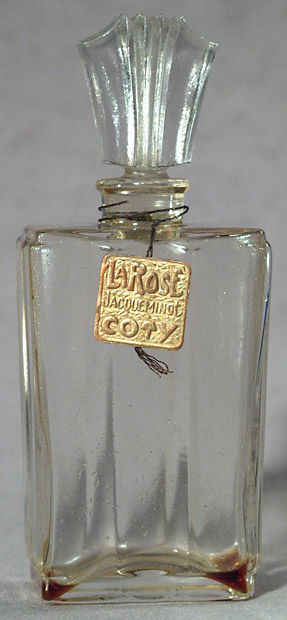
His first fragrance, La Rose Jacqueminot, launched in 1904, made him a millionaire.
Coty packaged it in a Baccarat crystal bottle because he believed from the start that the object holding the scent was inseparable from the experience of wearing it. He later partnered with René Lalique, the celebrated Art Nouveau glass designer, who created ornate bottles and gilded labels for early Coty creations, including L'Origan. The bottle was a total part was part of the creation.
There is a well-known story from those early days. After being turned away by the director of Le Grands Magasins du Louvre, Coty dropped a vial of La Rose Jacqueminot on the department store floor. The scent filled the air, women gathered, and he left with an order. Whether calculated or not, it illustrated something he understood better than most of his contemporaries: that a fragrance has to be smelled to be sold, and that projection is part of the product.
Democratizing Fragrance
Coty was among the first to offer fine fragrances to middle-class and working-class women, in smaller bottles at lower price points. The quality didn't drop at all, and the audience widened. No, he didn't dilute the product; he rethought who it was for, and in doing so, he transformed perfume from a luxury reserved for the wealthy into a mass-market category. That shift still defines how fragrance is sold and distributed today.
He acquired a factory space to control the production at scale and expanded it into cosmetics. Coty, Inc. was formally established in New York in 1922, with subsidiaries following in the UK and Romania. In 1935, the launch of Air Spun face powder became one of the great cosmetic successes of its era, and remains in production today.
The Chypre Legacy
In 1917, Coty introduced Chypre, French for Cyprus, a fragrance built around oakmoss, labdanum, and bergamot. That accord became the structural foundation for an entire fragrance family that perfumers across houses have worked from ever since. Guerlain's Mitsouko, Hermès Calèche, Estée Lauder Aliage: all draw from the same blueprint. It is one of the more stilly consequential contributions in the history of modern perfumery, the kind of creative act whose influence outlasts the name attached to it.
After François
François Coty died in 1934, and the company's trajectory changed with him. His ex-wife. Yvonne, sold Coty to Pfizer in 1963, which shifted distribution almost entirely to drugstores and mass retailers for the next three decades. The company changed hands again in 1992, coming under Joh. A. Benckiser GmbH, and repositioned itself at the top tier of the industry.
Today, Coty operates across two divisions: Coty Beauty and Coty Prestige, managing close to 40 brands, including Chloé, Hugo Boss, Calvin Klein Fragrances, and Gucci Beauty.
Scents Worth Knowing

Ex'cla-ma'tion (1988). A drugstore classic built on peach, apricot, vanilla, and amber. Warm, slightly spicy, very much of its era, and still worth tracking down for what it tells you about where mass-market femininity sat in the late 1980s.

Aspen.
A well-made aromatic fougère: mint, citrus, cedar, amber. A useful reference point for what accessible masculine fragrance looked like before the category became oversaturated with near-identical interpretations.

Infiniment Coty Paris, Aristo Chypre.
A luxury chypre that knowingly calls back to the 1917 original, built around rose, patchouli, and the classic accord. If you want to feel the distance between where Coty started and where it stands today, this is where to begin.
Then and Now
One hundred and twenty years after a broken vial of La Rose Jacqueminot filled the air of a Paris department store, Coty launched Infiniment Coty Paris, a 14-piece collection of genderless fragrances conceived by CEO Sue Nabi and co-founder Nicolas Vu.
The timing was a centennial statement, a deliberate return to the idea that Coty is, at its core, a fragrance house first.
The collection is built around molecular aura, a proprietary time-release technology developed to enhance projection and longevity. Nabi describes it as a diamond placed inside a fragrance to amplify every layer of the scent, not just at first spray but over time. It is a scientific answer to the same question François Coty was asking in 1904: how do you make sure people smell it?
The bottles, designed by Vu in crisp white and shaped in the letter I, are organized into three olfactive chapters: I am Dawn, I am Day, and I am Dusk, moving from brighter, more intimate openings toward deeper, more sensual finishes.
Encore Une Fois, one of Nabi's favorites in the collection, translates simply as "one more time," named for the impulse to keep reaching for the bottle.
Un Parc de Roses en Alabama, conceived by Vu as a tribute to Rosa Parks, pairs spicy leather and myrrh with rose petals. A rose with thorns, as Nabi puts it.
What is interesting about Infiniment Coty Paris is what the collection represents for a house that spent several decades defined by its drugstore footprint.
François Coty believed that luxury and accessibility were not opposites, that you could offer something genuinely beautiful at a price that didn't exclude most of the people who might want it. The mass-market pivot after his death was, in many ways, was an abandonment of the second half of that equation. Infiniment Coty Paris restores the first half without apology, and the price tags are not drugstore ones.


Comments